Uncovering the CX – Operations Gap

When Dashboard Metrics are Healthy, but Customers Disagree
read more

Back to all posts >

Ask anyone working to improve customer experience (CX) and you’ll hear a common struggle: it’s hard to know what really matters to customers. People say one thing in surveys, but act differently when it’s time to make a decision. You might spend weeks building a feature that customers asked for, only to find that hardly anyone uses it.
That gap between what customers say and what they actually do is where a lot of businesses get stuck. This is where conjoint analysis can make a real difference.
Most CX programs lean heavily on feedback surveys, reviews, or Net Promoter Score. While these tools capture how customers feel, they rarely capture why customers churn, downgrade, switch providers, or disengage. Sentiment alone can’t reveal the hidden decision rules that drive behavior.
Conjoint analysis, on the other hand, is a powerful market research method designed to uncover what people truly value by mirroring real-world decision-making. Instead of asking customers to rank features, check boxes, or rate satisfaction, it presents them with realistic choices between different product or service configurations. Each option varies on attributes such as price, features, speed, or level of support forcing respondents to make tradeoffs, just as they do in everyday life.
By simulating different choice scenarios, conjoint pinpoints which aspects of the experience customers truly prioritize. It separates the features that keep people loyal from the ones they barely notice.
With conjoint, CX teams can clearly see:
This prevents wasted resources on enhancements customers don’t care about, and instead directs focus toward levers that genuinely influence decisions. In short, conjoint analysis moves CX from guesswork to clarity, revealing the “why” behind customer actions and helping teams design experiences that align with real customer priorities.

Imagine you run a meal delivery service and you’re trying to reduce churn. Your team thinks customers want more meal variety and lower prices, but you decide to run a conjoint analysis to compare different attribute combinations:
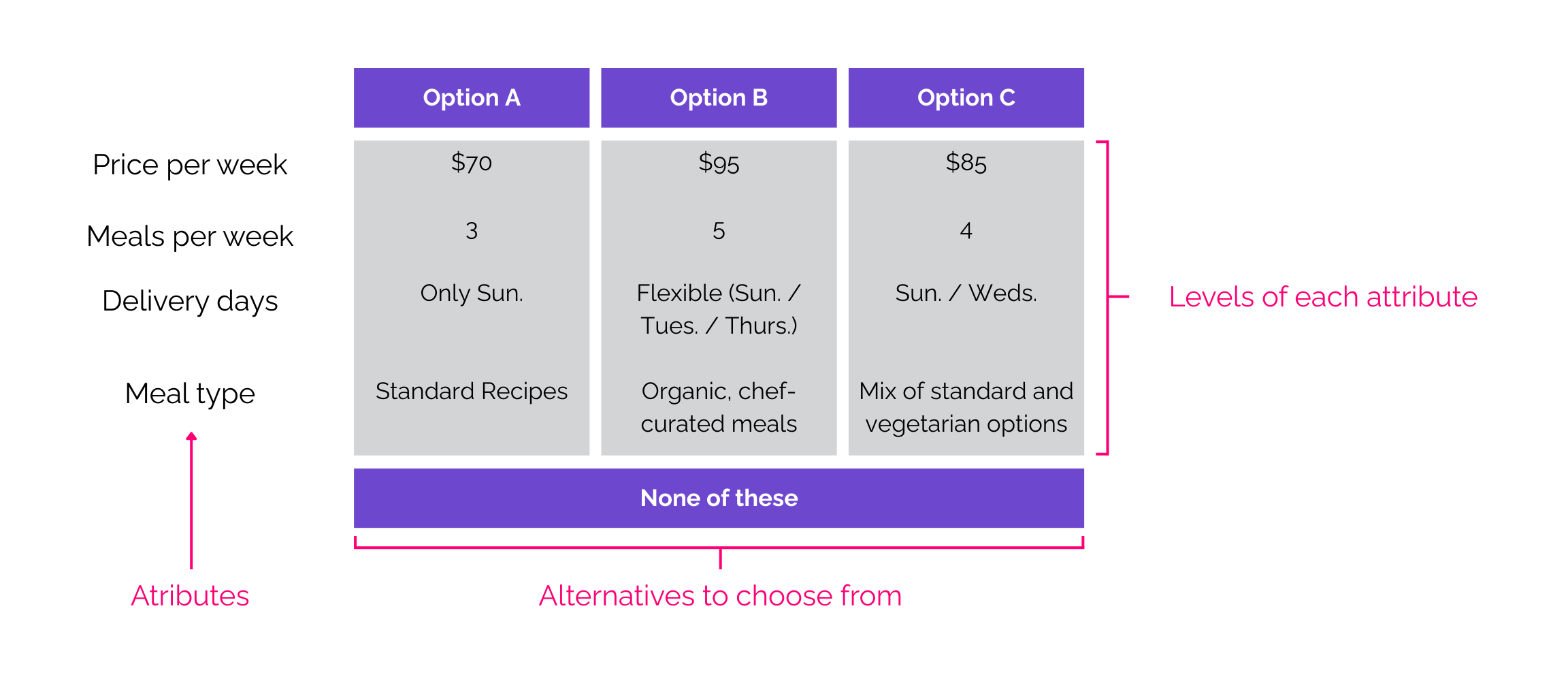
By analyzing these choices, conjoint reveals:
Your team learns that customers accept higher prices for flexible delivery dates and that the number of meals per week matters more than anything else. Now your team knows where to focus. Changes are made to improve scheduling and new deals for larger serving sizes are introduced. Customer satisfaction goes up and retention follows.
The result is a data-driven understanding of how customers evaluate tradeoffs; something traditional surveys often fail to capture.
Conjoint is especially helpful when you’re testing changes before rollout. Whether you’re adjusting pricing, adding service tiers, or changing the interface, conjoint lets you predict how customers will respond. You can test ideas early and avoid rolling out something that backfires.
It’s also a great way to personalize experiences. With the right data, you can see how different customer segments prioritize different features and tailor your approach accordingly.
If CX is truly a priority, you need more than good intentions and surface-level feedback. You need to understand the why behind customer behavior; what actually drives people to stay, leave, upgrade, or disengage. Conjoint analysis gives you that clarity.
Instead of guessing which improvements will boost satisfaction or loyalty, conjoint provides hard evidence about what matters most to your customers. It highlights the features and experiences that genuinely influence decisions, helping you avoid dead-end investments and make smarter, more confident product and CX choices.
Customer expectations have never been higher, and budgets have never felt tighter. Conjoint analysis helps you meet, and exceed, those expectations without wasting time or resources on the wrong things. It gives you the insight to design experiences that resonate, differentiate, and ultimately keep customers coming back.
Beth Reddy, Junior Data Scientist
Uncovering the CX – Operations Gap

Bridging the gap between intent and reality.

Connecting dots between customer behavior, real-time feedback, and business impact
to a detailed overview of our Market Research services, including our core pillars and capabilities!
